They’re designed to do a serious job while still looking like doors that belong in real homes.
Here, we’ll walk you through what Deanta fire doors are, why they’re trusted and what makes them a popular choice for homeowners, landlords and developers alike, without drowning you in technical jargon.
What does a fire door actually do?
In simple terms, a fire door helps slow the spread of fire and smoke through a building. It doesn’t stop a fire completely, but it buys time, and in a fire situation, time is everything.
That extra window can mean the difference between a safe escape and a dangerous situation. Fire doors are especially important on staircases, between garages and homes, and in multi-storey properties where fire can spread quickly from one level to another.
Do you really need a fire door?
In many UK homes, fire doors aren’t optional. Building regulations under Approved Document B, requires them in new builds, loft conversions, flats and properties with integral garages. Landlords and developers are usually very familiar with these requirements, but homeowners are often caught out when renovating or extending.
Even when they’re not strictly required, many people choose to install fire doors for added peace of mind. Kitchens, stairwells and garages are common areas where a fire door makes practical sense, especially if you’re already replacing internal doors.
Why choose Deanta fire doors over other options?
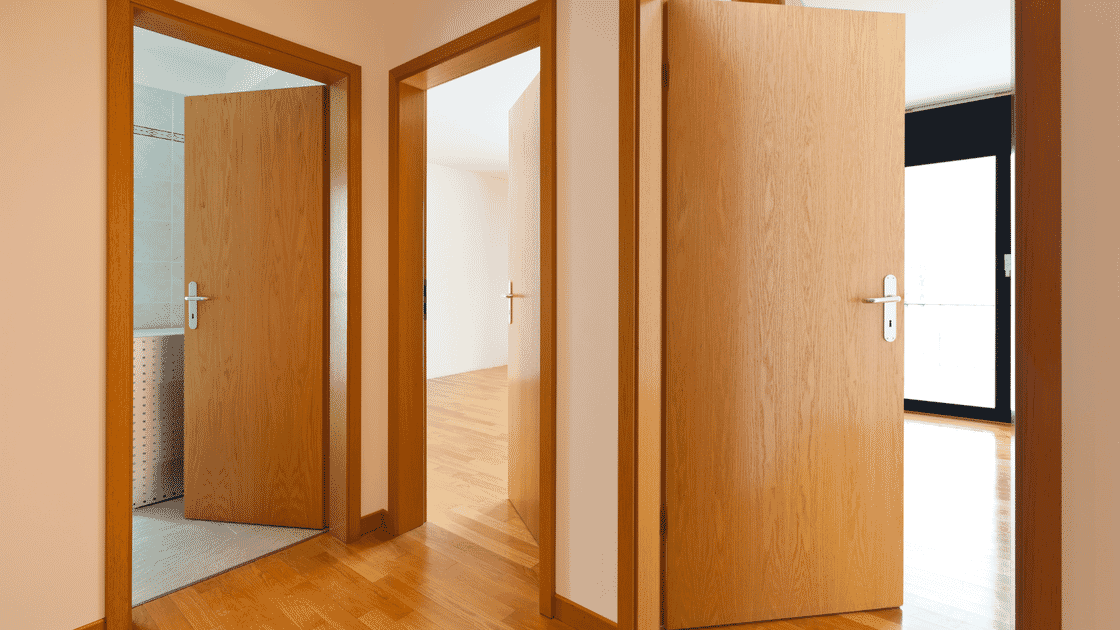
One of the biggest concerns people have when shopping for fire doors is how they’ll look. There’s a common assumption that fire doors are thick, clunky or obviously “commercial”.
Deanta fire doors are designed specifically to challenge that idea. They’re styled to match Deanta’s internal doors, meaning you can often pair a fire door with a non-fire-rated version in the same design. Visually, there’s very little difference, which makes them ideal for modern homes where consistency matters, the only real thing you might notice is the weight of the fire door (heavier) and they’re marginally thicker (10mm), but this can be accommodated when fitting the frame.
This makes Deanta fire doors particularly popular in open-plan layouts, new builds and renovations where homeowners don’t want safety features to stand out for the wrong reasons.
Many Deanta fire doors carry Q-Mark certification too, which is one of the most respected third-party fire safety schemes in the UK and not something all fire door manufacturers have.
Buyers will often ask what Q-Mark actually means, and the simplest way to explain it is this: it’s ongoing proof of compliance, not a one-off test during the manufacturing process.
Q-Mark Certification Explained
One of the biggest selling points of Deanta fire doors is their Q-Mark certification and it’s worth understanding why that matters.
Many fire doors are tested once, approved and then mass-produced. Q-Mark goes further. It’s an independent certification scheme that doesn’t just test the door design, but keeps checking that the doors being made today are still up to the same standard.
For you as a buyer, this means reassurance. It means the door hasn’t just passed a test at some point in the past, but is being made consistently, under regular inspection. For landlords and developers, it also offers an extra layer of protection when it comes to compliance and accountability.
In short, Q-Mark helps remove the guesswork.
FD30 or FD60… what’s right for your home?
If you’ve started to browse fire doors, you’ve probably seen FD30 and FD60 mentioned a lot. These ratings simply refer to how long the door can resist fire under test conditions. Deanta, like the stars that they are, offer a wide range of both.
- FD30 fire doors are designed to resist fire for up to 30 minutes and are the most common choice for residential properties. They’re typically used on staircases, between garages and homes, and near kitchens.
- FD60 fire doors offer up to 60 minutes of resistance and are usually specified in higher-risk areas or commercial settings. Most homeowners won’t need FD60 doors unless advised by building control or a fire safety professional.
What are Deanta fire doors made from?
Deanta fire doors are built around a dense, fire-resistant core, usually made from solid timber composite or other high-density materials that burn slowly and hold their shape under extreme heat.
The fire-resistant core is made from high-density, slow-burning materials that are designed to hold their shape under extreme heat rather than collapsing quickly.
Typically, this core is made from engineered timber products, such as high-density particleboard, solid timber composite or materials like flaxboard. These materials are chosen because they burn in a predictable, controlled way, which helps the door maintain its integrity for 30 or 60 minutes during a fire.
Unlike standard internal doors, which may have hollow or lightweight cores, fire door cores are dense and heavy. That density is what gives fire doors their solid feel and is a key reason they can resist fire long enough to protect escape routes and slow the spread of smoke.
Neither particleboard nor flaxboard is considered structural, so the core is then reinforced with solid timber lippings around the edges, which strengthen the door, protect the core and allow limited trimming during installation. On the outside, the door is finished with decorative facing layers such typically made from real wood veneer which is then either fully finished or a left as a primed surface, all bonded using fire-resistant adhesives so they don’t fail early if there is a fire.
Glazed Deanta Fire Doors: Light Without Compromise
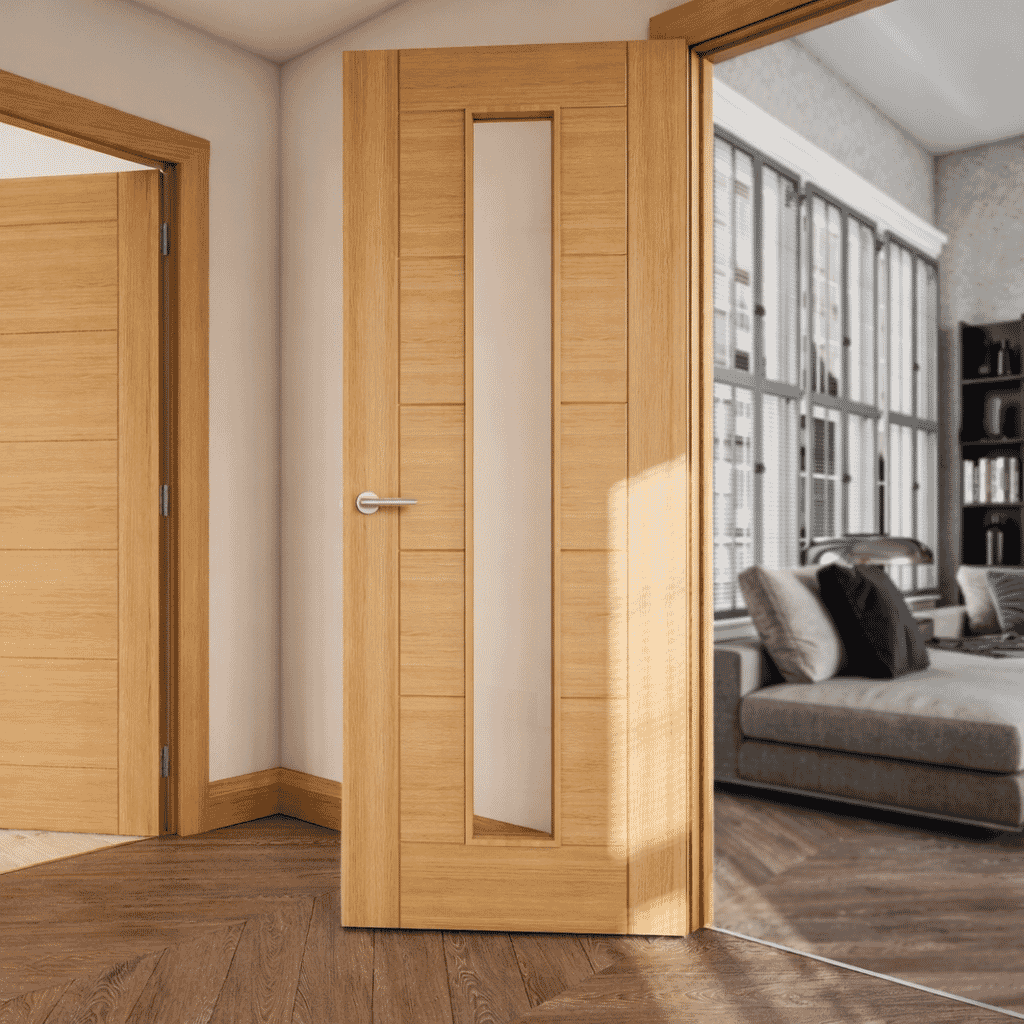
Deanta glazed fire doors use fire-rated glass that’s been tested as part of the complete door set. This is important, because fire doors need to work as a whole system rather than a collection of individual components.
Glazed fire doors are a great option if you want to allow light to flow through hallways, landings or open-plan spaces without having to compromise on safety. They’re particularly useful in linear homes such as terraces, where natural light is limited.
Deanta Fire Door Sizes
Deanta offer a wide range of fire door sizes to accommodate most needs, whether you need a slimline FD30 fire door or a wider FD60 rated door, Deanta can like provide the fire door you need. Below you'll find all the fire door sizes on offer across their FD30 and FD60 fire doors:
| Imperial Fire Door Sizes (FD30) |
|
|
|
| Height |
Width |
Inches |
Thickness |
| 1981 mm |
457 mm |
18" |
44 mm |
| 1981 mm |
533 mm |
21" |
44 mm |
| 1981 mm |
610 mm |
24" |
44 mm |
| 1981 mm |
686 mm |
27" |
44 mm |
| 1981 mm |
711 mm |
28" |
44 mm |
| 1981 mm |
762 mm |
30" |
44 mm |
| 1981 mm |
813 mm |
32" |
44 mm |
| 1981 mm |
838 mm |
33" |
44 mm |
| 1981 mm |
864 mm |
34" |
44 mm |
| 1981 mm |
914 mm |
36" |
44 mm |
Imperial sizes are the core UK stocked FD30 sizes used across most ranges.
Metric Fire Door Sizes (FD30)
|
|
|
| Height |
Width |
Thickness |
| 2040 mm |
426 mm |
44 mm |
| 2040 mm |
526 mm |
44 mm |
| 2040 mm |
626 mm |
44 mm |
| 2040 mm |
726 mm |
44 mm |
| 2040 mm |
826 mm |
44 mm |
| 2040 mm |
926 mm |
44 mm |
Metric door sizes are commonly used for European-sized openings or newer build properties.
|
|
|
|
| Height |
Width |
Thickness |
| 1981 mm |
610 mm |
54 mm |
| 1981 mm |
686 mm |
54 mm |
| 1981 mm |
762 mm |
54 mm |
| 1981 mm |
813 mm |
54 mm |
| 1981 mm |
838 mm |
54 mm |
| 1981 mm |
864 mm |
54 mm |
| 1981 mm |
914 mm |
54 mm |
FD60 fire doors provide 60 minutes of fire resistance and are most typically used in commercial buildings, HMOs and communal corridors.
Installation Matters More Than You Realise
Even the best fire door won’t work as intended if it’s not fitted properly. Fire doors rely on correct installation, suitable frames and fire-rated ironmongery to perform as a complete system.
This is why it’s always recommended to use a competent installer and follow the manufacturer’s guidance closely.
Do fire doors need special hinges and handles?
This is something that often catches people out. A fire door is only as good as its installation.
Deanta fire doors must be fitted into suitable frames and installed with fire-rated hinges, handles, and latches. The gaps around the door also matter. If a fire door is poorly fitted, it may not perform as intended, even if the door itself is fully certified.
This is why following the manufacturer’s guidance is so important. Many failed inspections come down to installation issues rather than problems with the door itself.

Can Deanta fire doors be painted and trimmed?
If you’re buying a primed Deanta fire door, it can be painted to suit your interior, as long as the manufacturer’s instructions are followed. This makes them a flexible option for people who want to colour-match their doors to walls or woodwork.
Fire doors can also be trimmed, but only within the stated limits, which tend to be pretty limited on fire doors. Excessive trimming can affect fire performance, which is why it’s always important to check guidance before making any adjustments. If you find
A Few Everyday Benefits You Don’t Always Expect
While safety is the main reason for fitting a fire door, many people notice extra benefits once they’re installed.
Deanta fire doors often provide better sound insulation due to their build, feel more substantial than standard internal doors as they’re weightier and cope better with busy households and high-traffic areas too.
Basically, they’re built to last, not just to pass a test.
Are Deanta fire doors worth it?
We think so! If you’re investing in fire doors, you want them to do three things well: protect people, meet regulations and look right in your home. Deanta fire doors manage all three.
They offer trusted fire performance, thoughtful design and the added confidence of Q-Mark certification. Like all other types and styles in the Deanta Doors range, whether you’re renovating, building or upgrading for peace of mind, they’re a sensible, well-rounded choice.

 Order Helpline:
 Search
 Email
Email Cart (0)